
You are using an out of date browser. It may not display this or other websites correctly.
You should upgrade or use an alternative browser.
You should upgrade or use an alternative browser.
Are These the Same Hand
- Thread starter MollyMay
- Start date


AnnB
Editor in Chief who is Hot off the Press!
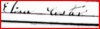
Looks like the same signature to meView attachment 742 View attachment 743
These two signatures were written on 23/4/1848 and 8/8/1848 would you agree that they are one and the same lady?

Ann

There are differences but I would say they are the same. Subconsciously whenever you write something your brain can't help but do certain characters in a certain way. You may try to change the way you write your name but you still end up doing some things the usual way. Both first names start with 'E' and in both cases they are written like back-to-front 3's. The preceding tail on both C's is another give away. Ok the 'L' slants more in the first one but it also slants slightly in the second. If I was asked to say which signature was written first I would have put the second picture. The first seems to have more confidence. Whereas the second seems rather small as if lacking confidence or under pressure with others watching.
Bet you wish I hadn't answered now but why just use 5 words when you can use 100's
Bet you wish I hadn't answered now but why just use 5 words when you can use 100's

MollyMay
Knows where to find the answers!
Thank you Ann and Chimp , I was pretty sure they were but....
the 23/4/8/1848 signature was on Eliza's marriage to Thomas Phillips (where she is noted as under age) second sample, the earlier one by just over three months - clever Chimp!
and the 8/8/1848 was when she witnesses the marriage of John West and Harriet Turner - first sample.
So why was she signing in her maiden name?
I think my Wests are more trouble than they are worth!
the 23/4/8/1848 signature was on Eliza's marriage to Thomas Phillips (where she is noted as under age) second sample, the earlier one by just over three months - clever Chimp!
and the 8/8/1848 was when she witnesses the marriage of John West and Harriet Turner - first sample.
So why was she signing in her maiden name?
I think my Wests are more trouble than they are worth!
Maybe she hadn't got used to the idea of writing her married name and just wrote the name without thinking. To late once she had started. Probably thought oh goodness me (or words to that effect) I've written the wrong name. It was probably a talking point at the after doo with everyone laughing about it.

Just another observation. Back in 1848 how many times would a married woman have to write her name. Mostly back then the Husband did all the signing. She probably wouldn't have had to sign her married name in the 3 months between signatures and so signed the name she knew without even thinking.


Archie's Mum
Always digging up clues
They are a little different but I agree, the same.
A little bankies trick I learned early in my working life was to fold one of the signatures in half horizontally. Place that sig over the other, the fold in the centre of the one underneath. If the spacings and flow of the writing meld then it is the same person.
A little bankies trick I learned early in my working life was to fold one of the signatures in half horizontally. Place that sig over the other, the fold in the centre of the one underneath. If the spacings and flow of the writing meld then it is the same person.

Ken_R
Well-Known Member
A little bankies trick I learned early in my working life was to fold one of the signatures in half horizontally. Place that sig over the other, the fold in the centre of the one underneath. If the spacings and flow of the writing meld then it is the same person.
I'd never heard of that one before.
I also think it is the same person.
What is not often considered is the position of a left-handed person when signing a book based document. When entering a field to the left, as in an 1848 marriage, then the flow of the hand can be inhibited by the spine of the register, hence a need to 'angle' the script.
Signing as a witness, it is more towards the right of the page and therefore less hampered.
Do you know the page number in the register? The further I get into a cheque book the more difficult it becomes to write legibly on the counterfoil.
Why can't we have cheque books like the French, with the spine across the top?

Old Stoneface
Well-Known Member
Why can't we have cheque books like the French, with the spine across the top?
My/our (French) cheque book has counterfoils at the left-hand side of the cheques; in a way, it's a pain as it makes it long and it needs to be folded in half to go in a bag, which the top spine ones don't. Strange, because our British cheque book also has end-on counterfoils and yet it's shorter. It must be all these quatre-vingt-dix-neuf sss that you have to write out; ninety-nine is so much shorter

My sister has a left-handed chequebook (counterfoils to the right), and my parents had cheque books without counterfoils, but with the debit/credit pages at the front.
I definitely think you should ask your bank for a display of the full range of cheque books on offer!