Help understanding a Will - Tax/Duty?

Boadicea

New Member
Hello

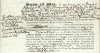
Can anyone explain what the sum of four hundred pounds is on this administration of a will. Could it be some type of duty or tax? If it is, it seems exorbitant. Below is the transcript of the relevant part of the document:


Know all Men, by these Present, That We Joseph Pitchforth, of the Township of Fixby in the Parish of Halifax, in the County of York, Wool Sorter, Hannah Brook of Fartown in the Parish of Huddersfield, Widow, George Binns (in behalf of Mary Ann Brook, his wife) of Fartown, School Master, George Edward, Solicitor, George Halliley Edwards of Halifax, Solicitor Do stand and firmly bounden and obliged unto the Worshipful GRANVILLE HARCOURT VERNON, Master of Arts, Commissary of the Exchequer Court of the most Reverend Father in God Thomas by Divine Providence Lord Archbishop of York, Primate of England and Metropolitan lawfully constituted, in the sum of Four Hundred Pounds of good and lawful Money of Great Britain to be paid to the said Commissary or his true and lawful Attorney, Executors, Administrators or Assigns, to the which Payment well and truly to be made. We bind us and each of us jointly and severally, for and in the whole, our and each of our Heirs, Executors and Administrators, and every of them firmly by these Presents, Sealed with our Seals. Date the twenty-second Day of the Month of February in the Year of our Lord One Thousand Eight Hundred and Fifty–one.​


In 1850, William bequeath cottages at Elland, possible 4, to his children. The will does not give the number of cottages, but William inherited 4 cottages situate at Elland from his uncle in 1831. I can't imagine that the cottages were worth a great amount of money.

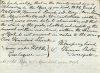
On page 3 of the probate there is a oath by the Surrogate that the administrators swore that the 'whole of the good chattels and credits' of the deceased is valued under two hundred pounds.

Am I right in assuming that this amount relates to the movable (personal) part of William's estate and not the properties?

From Kieth Pitchforth, I have learnt that this amount was 113-15-6 and the duty was 1-3-0.

I would like to know Keith's source for this amount as it is not in the admon package I got from the Borthwick Institute.

Any help would be most appreciated

Warm Regards
Karen
 

Attachments

  • W Pitchforth - Will p2.jpg
    W Pitchforth - Will p2.jpg
    586.1 KB · Views: 9
  • W Pitchforth - Will p3.jpg
    W Pitchforth - Will p3.jpg
    700.4 KB · Views: 7
Can anyone explain what the sum of four hundred pounds is on this administration of a will. Could it be some type of duty or tax? If it is, it seems exorbitant. Below is the transcript of the relevant part of the document:

Know all Men, by these Present . . .​
Hello Boadicea

What you have there is the first part of an administration bond. In this and other types of bond, the sum of money mentioned was a penalty which would only have to be paid if the bondsmen/women failed to do whatever they were promising to do.

What their promise was should be set out in the next part of the bond, which should begin with the standard phrase 'The condition of this obligation is . . .' In an administration bond I'd expect the promise to be delivery of an inventory to the court by a certain date.

I think it was standard practice for the penalty to be twice the value of the estate.
 
Hello Huncamunca

Thank you. Wow, that is very interesting.

Yes the next paragraph states that they were to bring to the Court of York a 'Just Accompt' of 'Credits, Goods, Cattles and Chattels. No Date, just 'when they are lawfully called'.

Does 113-15-6 pounds seem like a small sum of money for 4 cottages and appurtenances for 1850?

Warm Regards
Karen
 
Sorry for the delay in replying, Karen: I've only just got back from a weekend away.

On page 3 of the probate there is a oath by the Surrogate that the administrators swore that the 'whole of the good chattels and credits' of the deceased is valued under two hundred pounds.

Am I right in assuming that this amount relates to the movable (personal) part of William's estate and not the properties?

R.J. Morris (2005), Men, Women and Property in England 1780-1870 - quoted in another book online - says that 'The ecclesiastical courts only had jurisdiction over personal property and it was this alone that was taken into consideration when establishing the value of an estate.'

Once I thought I knew the difference between real and personal estate but it's not (or it wasn't) as clear-cut as I thought. Some leasehold property counted as personal estate, and in some circumstances copyhold property did too. There are some explanations (too complex for me to grasp!) in this 1834 book by Thomas Gwynne:

https://
books.google.co.uk/books?id=vTlfAAAAcAAJ&pg=PA18

In short I don't know if the cottages might have been included in the total valuation or not.

Does 113-15-6 pounds seem like a small sum of money for 4 cottages and appurtenances for 1850?

I'm not sure: I'll do a bit of digging and see if I can find out about property prices at that time. It'll be tomorrow, though: my little nephew (6) and niece (3) have used up all my energy today!
 
Hello Huncamunca

Thank you very much for this information. I will have a look at the book now. This is a great resource.

Thank you again
Karen
 
For some background reading on costs of building houses and of typical rentals, see Local Reports on the Sanitary Condition of the Labouring Population of England (published in 1842), online here:
https://
books.google.co.uk/books?id=FJZDAQAAMAAJ

This fascinating volume covers many different parts of the country. This quote (from p.358) is from a description of back-to-back housing in Leeds:

Two such houses are ordinarily built for a cost of from 65l. to 70l. each, which with the land, raises the entire cost to about 80l. a house. The average repairs may amount from 5s. to 10s. a-year. When new, these houses will let for 12l. a-year...
But how that would compare with Elland prices I don't know - and of course factors such as size and condition of the cottages are unknown quantities.

Sale prices are hard to discover. Though newspapers are full of advertisements for auction sales of property, it is rare to find reports of the prices realised. If deeds have survived that would be a good place to look.

You are more likely to find a rental value, e.g. in land tax records (there are some for West Yorkshire on Ancestry, which might be worth checking).

(By the way, have you seen the electoral registers there too, which have details of some Pitchforths owning property in Elland?)
 
Hello Huncamunca

Please forgive me for taking so long to reply. 3 days a week I am in the country without internet - ugh.

Thank you for the link and thank you for copying the text. It is interesting, oh those back-to-backs must have been oppressive, and quite useful just to get an idea on the price of property.

I have found William on electoral registers but have not been unable to find land tax records. Nothing much in newspapers, but will have another look.

I very much appreciate your help. Both links are very useful and great reading

Warm Regards
Karen
 
Hello again Karen

3 days a week I am in the country without internet - ugh.
No internet for 3 days a week: I don't think I could cope! But I might get a lot more work done.:rolleyes:

I have found William on electoral registers but have not been unable to find land tax records.
There are Elland records in Ancestry's 'West Yorkshire, England, Select Land Tax Records, 1704-1932' database.

Some owners/occupiers are listed with abbreviated forenames, or just an initial or no first name at all, so try leaving the forename field blank.

The 1845 list I'm looking at is arranged roughly alphabetically by surname of proprietor: there's a Wm Pitchforth there, owning property just listed as 'building' occupied by Gledhill & Co. Rental value £4 7s. 6d.

In the 1852 list what appears to be the same property is shown as owned by 'Pitchforth Wm & Coy' [the 'y' is superscript: this is probably an abbreviation for Company]. This may just mean 'and others'. As this list dates from after your William's death, this William may not be your man, or the list may be out of date, or the '& Coy' could include executors/administrators etc.

If there's a good run of lists for Elland you might be able to see when this William first appears, and whether that ties in with what you know about when your William inherited the property.
 
Hi huncamunca

I was able to find 10 Land Tax Records that I am confident are for William.

The 1852 entry could be due to the time it took to finalisation his estate. William's probate was not completed until mid 1851, so there would have been tax owing for that year and was probably due to be paid in 1852.

thank you
 
Back
Top