Deciphering of attestation papers- help!

annabel

Puts the Heart into Hertfordshire
I was recently helped to find some attestation papers on, another thread, for Valentine Welton. I went to look at them today, and realised that I could not understand some of it. TNA knew that he died, but I can't see it on his papers anywhere

Can anyone work out what this says or means?

Valentine.png
or this, because it also says he enlisted 11th Jan and attested 13th Jan 1842, and this is something else
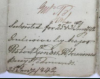
Valentine2.png
Thank you
 
The first one begins 'DD 22 Sep 1842'. I'm not sure about what it says at the end of the line, maybe Hd something. The DD is explained in this guide to abbreviations found in Royal Marines' service records:

http://www.
royalmarinesmuseum.co.uk/item/researching-family-and-royal-marine-history/abbreviations-found-in-rm-service-records

'DD Discharged Dead (usually written in red pencil or heavy black ink)'
 
As for the second image, I can't decipher the red squiggles at the top. The black bits say something like

Subsisted for 25(th?) & 31(st?) Jany 42
Inclusive by Major
Robert Gordon(?) Rl Marines
Bury St Edmunds
25th Jany 1842


The officer's surname looks more like Gondon but I cannot find such a person.
 
Thank you, that explains where they got that he was dead. Do you know what they mean by subsisted? Looking it up in the dictionary, do you think it means they had to help him with his living costs before he was moved to the Marines base? Elsewhere it says they had to buy him a shirt on 24th Jan
 
Do you know what they mean by subsisted? Looking it up in the dictionary, do you think it means they had to help him with his living costs before he was moved to the Marines base?

I'm not sure, annabel. It may have been an advance payment to tide him over: the OED defines subsist money, or subsistence money, as 'Money paid in advance to soldiers, workers, etc., to supply their needs until the regular pay day'.

P.S. If there are pay books (at Kew?) they should show when pay day was. Perhaps the next pay day after he joined was 1 February, so he was given an advance just for those last few days of January?
 
Last edited:
Now, I know that this refers to actions happening 100 years earlier, but I have found this:

Officers were not entitled to free rations while in garrison, but many made arrangements with the commissary agents to provide them, their families, and their friends with free food. When campaigning in the field, officers would subsist on army rations; however, the existing policy of garnishing their wages to pay for those rations was almost never followed.

(Source: almc.army.mil/alog/issues/SepOct99/MS409.htm)

So, I was thinking that it referred to a subsistence allowance for the dates mentioned.

(Speaking as a former Civil Servant, we used to be able to claim subsistence for meals if we were working away from our home office.)
 
"Subsistence" is a common term (to my generation, at least!). When I've been off to Conference, I can claim for "Travel & Subsistence" - ie Fuel & Food. (We got nothing for drinks at the Bar :()

Jane

Not that I go to Conferences nowadays ... I'm too busy with my ancestors :D
 
Thanks.....I would not have known that. Here in Canada it is simply expenses.

One thing I was told....by the OH here......replying to another researcher. When not at war, soldiers, etc. are on half pay. One of my Allanby men from Flimby CUL was in PEI 50 years before the Bownesses and made the mistake of buying about 11,000 acres of land for 400 GBP. Had to abandon it when he went on half-pay........or hopefully he sold it. His wife wrote some really snarky letters back home asking for money and I got snippets of those. :D
 
Thank you everyone. So I reckon he needed help with food before he left (he got 2shillings 6d and the shirt) having been seduced by the "bounty of £3 17s 6d". No wonder, poor boy was an orphan with only little siblings in the workhouse.
 
Back
Top