Latin paleographer needed, please

Old Stoneface

Well-Known Member
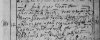
I know that this is the marriage entry of Thomas Mills of the parish of Stone and Mary Sherratt of the parish of Leek who were married on 21st July 1710, but is there anyone out there who can transcribe the Latin for me, please?Wedding Thomas Mills Mary Sherrat 1710.JPG
 
Hedore conjugali copulatiera?? in
Capella de Marbroock per thomas:
Walthall?? bic de Leek medich:

... best guess at moment ...
 
Change bic to "vic:"
means something like married in Marbroock Chapel by Thomas Walthall(?) Vic[ar] of Leek, but I don't do Latin ...

conjugali = marriage
copulatier = union
 
Last edited:
I don't either but had a peek in an online Latin/english dictionary
Hedora/e?, wedlock, copular=Coupling,copulari=cohabitating, Lady/mistress-(Capella)?chapel of Harbrooke/MArbrooke
by Thomas Walthall & ('sic')(Ia) Leek
possibles:
Ia
Assume this is capitalized proper name/abbr, under MODE IGNORE_UNKNOWN_NAME
sic ADV
thus, so; as follows; in another way; in such a way;

Liking the above better. Maybe doesn't do Latin but does lots of tranny work.

Agh, I'll go back to the kitchen. :(
 
There is a Marbrook in Leek, and there has been a chapel there since at least the 14th century, so it looks as though Mugwort is on the right track, again. (imagine green smilie, they're not working)
 
I'd transcribe it as:
Thomas Miller paroch[iae] Stone yeom: et
Maria Sherratt paroch Leek Spinst[e]r
F[o]edore conjugali copulati erant in
Capella de Marbroock per Thomas:
Walthall:[?] vic: de Leek predicti


I think the meaning has emerged by now, though Yeoman and Spinster appear to be English rather than Latin.

The word at the beginning of the 3rd line looks to me like a misspelling of a word for "union", with conjugali as the qualifying adjective; I'm pretty sure it's a capital F (written like "ff") rather than H.

I'm not sure what the symbol is after the vicar's surname and colon, looking like a 3. I don't think it's part of the surname, as a colon usually marks the abbreviation of the end of a word.
 
One can always rely on Mr K ;) ... I need more practice with Latin :oops:

I was toying with the idea of 'ff', and knew 'medich:' was dubious
 
I know that this is the marriage entry of Thomas Mills of the parish of Stone and Mary Sherratt of the parish of Leek who were married on 21st July 1710, but is there anyone out there who can transcribe the Latin for me, please?View attachment 1549

I cannot make out the date; is it 21st, 10th or perhaps 18th July? A chapel, in this context, is presumably a chapel-of-ease - in other words it was not the centre of a parish.
 
I'd transcribe it as:
Thomas Miller paroch[iae] Stone yeom: et
Maria Sherratt paroch Leek Spinst[e]r
F[o]edore conjugali copulati erant in
Capella de Marbroock per Thomas:
Walthall:[?] vic: de Leek predicti

Thank you very much, Arthurk; that's exactly what I wanted. ():-)
 
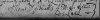
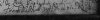
The vicar of Leek doesn't seem to have officiated at all the baptisms and weddings on the double page of the PRs where Thomas & Mary's wedding is. Their wedding is written out in full; others are just the two names & parishes and con : cop afterwards! However, he appears to have signed off each page at the bottom:

vicar's name.1.JPG
vicar's name.2.JPG
 
Last edited:
Somewhere I read that many Vicars, Rectors etc weren't all that proficient with their Latin so often used the wrong word or spelling, the article stated that we need to use some imagination with the interpretations.
 
I cannot make out the date; is it 21st, 10th or perhaps 18th July? A chapel, in this context, is presumably a chapel-of-ease - in other words it was not the centre of a parish.

My searches on Marbrook seem to infer it was a chapel of ease at the time of the wedding. These were built when the population of the parish had increased to a point where the church was unable to cope with the demands made on it for baptisms, marriages and burials, and quite literally eased the situation. The parish church was then often referred to as the Mother Church.

Depending on the size of the parish, in acreage, these chapels could be a fair distance from the Mother Church. An example of this can be found in the Worcestershire parish of Yardley, where the Job Marsden Chapel of Ease is about 5 miles from the parish church of St Edburgha.
 
Back
Top