I can only find one example of a handwritten 'als' at the moment:
View attachment 2459
Andrews al[ia]s Mootham [from a 1732/3 grant of administration in Hilary Marshall's wonderful palaeography book].
There's a line over the als to indicate that it is a contraction. In an unclearer hand this could look like a crossbar on a 't'. But it wouldn't explain why you've got an 'e' on the end of your mystery word, not an 's'. I am stumped

Huncamunca.......stumped you shall be no more! I believe you have hit the nail on the head!

And the problem is that I have been reading the 's' as an 'e' (which, in my defence, both of which the writer seems to write very similarly, as you can see by the 'e' in the word daughter!)!

I have run through and found a couple of the clearer entries, one of which I am attaching in the hope that you can read it.
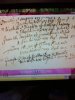
It is the 3rd entry up from the bottom, and reads: Jane, the daughter of Samuell Ffrancis ate/als Lord......March 17
Sorry I couldn't send it any larger.....TD wouldn't accept it in the larger format.
Obviously now that you have pointed it out Huncamunca, it is obvious that it is als short for alias! I have learned something today that I have never either seen or heard of before.

I cannot thank you enough and now I think I will go back and make them all dual entries....one under the surname Francis and the other under Lord, both with a note attached explaining how they were entered, which may help future researchers looking for Lords but only finding Francis's or vice versa.
A million thanks oh wise one Huncamunca! You are a real fountain of knowledge! What would we do without you? Cheers, Diana